

Food and drink manufacturers might be unfamiliar with konjac, but products containing the root could be their next competitor.
Konjac-based products are gradually surfacing across the food and beverage industry in a variety of products from salmon and shrimp to noodles, jellies, rice and drinks.
Derived from the konnyaku root, also known as devil’s tongue yam or elephant foot yam, konjac originated in China and was introduced to Japan in the 6th century, according to a blog post by Sakuraco, a Tokyo-based Japanese snack company.

The root is ground into a powder and mixed with water and limewater to create a rubbery texture, Sakuraco noted.
The US konjac market is projected to grow from $390 million in 2025 to $630 million by 2035, according to a Fact.MR analysis.
“USA, led by the West and Northeast regions, continues to demonstrate steady growth potential driven by weight management and health-conscious initiatives,” the report noted.
Konjac and gut health
Jonathan Carp, a medical doctor and founder of Miracle Noodle, said he first learned about the root in 2006, when he took a trip to Japan and tried konjac noodles.
“When I saw the health benefits of this product … I thought about my patients at home who were trying to transition to a healthier diet, and I thought that this would be just the perfect food for them,” he said.

The original konjac was made by Buddhist monks who used it for gut health, Carp explained.
“A long time ago, they had instincts about health that maybe they couldn’t explain in a modern scientific sense, but ultimately they knew that it was helping the gut,” he said. “And of course, now we know why, because a prebiotic fiber will help you populate essentially more of beneficial bacteria. It gives the beneficial bacteria food to digest, in a sense, and because it’s a fiber, it makes you feel full.”
The konjac fiber is packed with glucomannan, which is associated with a wide range of health benefits, Carp said.
His company produces a range of konjac-based noodles, rice and read-to-eat meals such as Vegan Pho, Thai Tom Yum Noodle Soup and Japanese Curry Noodles. The gluten-free noodles and rice contain roughly five calories and one net carb per serving.
“Konjac is one of those ingredients that can really help an enormous number of people, because gut health is increasingly important and we’re learning how important gut health is in the microbiome,” he said.
The diversity of konjac
Konjac has expanded beyond the typical noodle dish and begun making its way into squeeze packet fruit gels.
Everydaze, a konjac drink manufacturer in Flushing, New York, has been making jelly pouches since 2018.

“They’re completely vegan, they’re zero sugar, only five calories, gluten free, keto friendly, all the good stuff. They’re great sweet snacks for in-between meals,” said Kristy Agbulos, marketing coordinator for Everydaze.
The drinks come in a variety of flavors, such as grape, watermelon and mango, and are marketed as “inner beauty” snacks. Everydaze captures the functional drink trend by adding plant-based collagen and vitamin C to the konjac pouches.
“Kids don’t necessarily need collagen that early, so we made a version with vitamin C to be a little bit more family friendly,” she said.
Snack company Tastelli also brings konjac products to US consumers with jelly snacks in a pouch. John Kim, CEO and co-founder of Tastelli, described it as being like a hybrid of Jell-O and Vitamin Water.
He said konjac jelly is particularly popular with Gen Z and Millennial consumers, and social media outlets like TikTok are helping to drive the trend.
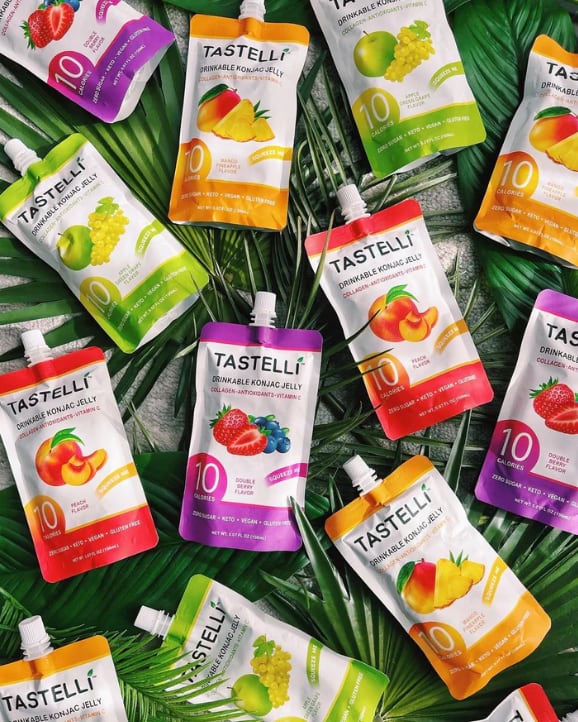
“I think there’s always an appetite for new types of snacks, so I think there are a lot of line extension opportunities for us,” he said. “We’re thinking about what’s next for us in terms of what type of functional benefits Gen Z and Millennials are looking for,” he said.
Konjac makes its way into sushi
Food manufacturers are leaning in on the health benefits of products that contain konjac blends.
It’s That Simple, an Austin, Texas-based food company, offers rice blends that include 50% konjac flour and 50% rice flour and are designed to cook in five minutes.
“A lot of folks use it as ingredients, lining agents, as a texture agent – we actually use it as one of the core ingredients of our pastas to make it super low cal and low carb,” said CEO Bryan Guadagno.

The company was illustrating the use of its rice product with a live sushi chef at the Natural Products Expo West 2026 show in early March.
“We realized that the rice is pretty sticky, and it really takes on that similar taste-texture experience of regular rice. We started rolling sushi with it, and as it turns out, it worked out great,” he said.


